The battle for indie publishers' tech stack heats up
Ghost just announced new features to keep up with Substack and Beehiiv's relentless pace


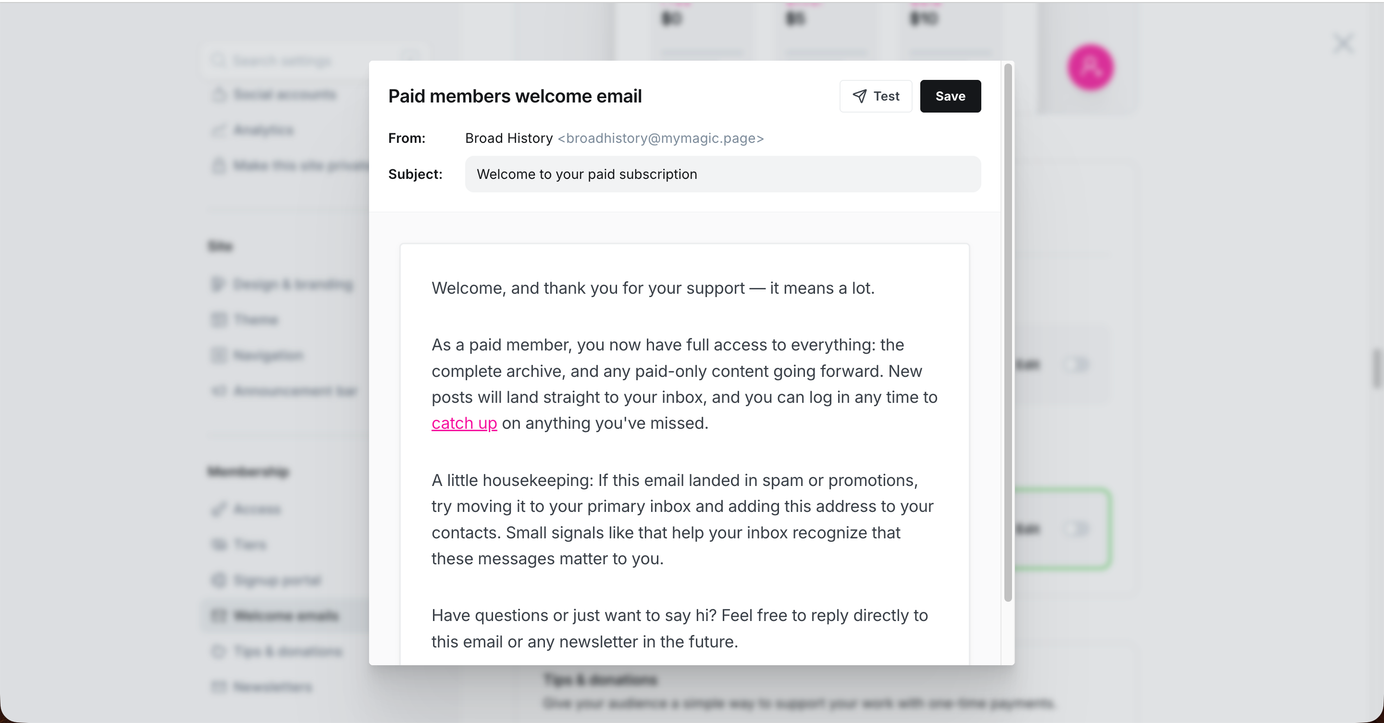
The open-source publishing stack Ghost just released the feature its users have been clamouring for – welcome emails. Now when a new reader signs up to a newsletter such as this one (yes, disclaimer: my two sites run on Ghost), they can receive an automated email gently nudging them down the sacrosanct audience funnel. Until now, Ghost publishers had to rely on third-party software to create that automation. Beyond this feature, Ghost teased a new product roadmap – "drip sequences, lifecycle messaging, re-engagement campaigns" – that signals the humble, bootstrapped Substack competitor is getting serious about enabling publishers' growth. It was time. Here are some initial thoughts this has sparked. Hit reply or get in the comments to share yours.
Users are unfair & challengers are always behind
Of course, welcome emails are hardly an innovation. It's audience-building 101. Smaller challengers like Ghost are doomed to play feature catch up. I remember at LinkedIn circa 2012, when Facebook would launch something new we'd have maybe a week before we'd start getting complaints from people expecting LinkedIn to work the same. Internet users go from having no idea something is possible to not remembering a world without it in a matter of days. Meanwhile, we had as many engineers as they had people in charge of changing the loo roll, and we could hardly keep the site online without a fail whale for more than a month. Consumer product comms was a nightmare because the first question at any launch was inevitably "wait, you didn't have that already?" (Tbf, we were asking for it when we launched native video in 2017, a decade after Facebook.)
But users don't see behind the curtain. They don't know who's just raised $100 million on a billion-plus valuation (Substack) and who's just crossed $9 million ARR after 12 years of bootstrapping open-source software inside a non-profit foundation (Ghost). They just want things the way they want them.
Outpost feels toast
I say this with no glee because they're a nice team, they built something cool and indispensable, and I don't think it's Ghost's vibe to try to bury other companies. But unless Ghost opts for acquiring over building, I'm not betting much on the future of Outpost. They built a whole business off of Ghost being slow to keep up with expected features, working as a layer over Ghost sites to automate welcome emails, offer gift and group subscriptions, create a metered paywall, etc. They are the only game in town to build an audience funnel (until now) and it works because for any reasonably successful publisher, Ghost + Outpost is still cheaper than Substack's brutal 10% cut. But in its success, Outpost only validated and derisked the market for Ghost, who are now running into the breach.
Add-on businesses are always vulnerable to their main guy catching up, like anyone who builds their house in someone else's backyard. This has been coming. Ghost first significantly improved their analytics and I dumped Plausible. I'm now coming to the end of my Outpost trial and... sorry, I won't be signing up.
Victory in the battle for indie publishers' tech stack probably lies beyond reader revenue
No one's taking the moral high ground from Ghost. It's a bootstrapped nonprofit building open-source software transparently within a friendly community. It is a legit marketing argument to indie builders who've fled corporate media and want to do things differently, especially when the option opposite is a venture-backed Silicon Valley company building yet another closed garden, enshittifying fast and taking money from Nazis.
Principles only matter as far as you can earn your keep though. Ultimately indie publishers need to build sustainable businesses. It's hard not to be tempted to switch when you see the growth other platforms enable. Ghost is catching up on the audience funnel, which will enable stronger reader revenue. I love memberships but that is still a one-legged stool of monetization. Enter Beehiiv, a third competitor who chose their lane clearly – diversified business models. When everyone else is building for membership, they're enabling advertising, merch, digital product sales... as well as reader revenue. They're making a big push in London right now, courting the biggest names on Substack and in online media to come over, and they're not leaving people indifferent. Ghost better build fast.
PS: I realize so many indie news sites are still built on Wordpress. Somehow we never talk about them.
Speaking of indie media, I've got a new gig... and room for another
I've started working on audience growth and sundries with Democracy for Sale. It's a blast! They're an indie newsroom launched by Peter Geogheghan investigating threats to British democracy from dark money to foreign influence. They're barely two years old and have a British Journalism Award and a gazillion scoops. It's so much fun working in the same room with other journalists again.
I'm a fractional exec, which means I get stuff done. Consulting didn't make me very happy – you try to lead a horse to water, and if they don't drink, you get to bill them again later. Not very satisfying. I prefer to be operational, which is perfect for small teams who need someone to take them to the next level without adding stuff to their plate and can't afford a full-time senior hire. I do strategy but I also jump in wherever I'm needed. Day 1 at D4S, that meant editing this cool scoop about Morgan McSweeney. That's the joy of indie media – a hand in every pot – and I wouldn't have it any other way. I've got plenty of experience in audience, product, strategy, editing and people leadership. It's all here. I've got room for one more such continuing gig in my schedule, reach out if that's you.

Hey, you read to the end!
Don’t miss future articles like this one; let me into your inbox.